Introduction
A travel agency can receive a customer’s payment without automatically knowing whether the booking is confirmed,the ticket has been issued,or the transaction has been recorded correctly. When these steps depend on manual checks,staff must switch between payment dashboards,booking systems,bank statements,and accounting records. Payment API automation connects these processes so that payment information can move between systems with less manual intervention. For travel agencies in Pakistan,this can improve online booking operations,payment tracking,customer communication,and financial reconciliation. With the right integration,a travel agency can accept supported digital payments,verify transaction results,update booking records,notify customers,and reconcile payments against its financial records. The exact level of automation depends on the payment provider,booking platform,airline or supplier rules,and the agency’s existing software.
Table of Contents
What Is Payment API Automation in Travel Agencies
Payment Gateway Services
A payment API is a technical interface that allows software systems to communicate with a payment service. It can enable an application to initiate a payment,retrieve a transaction status,process supported refunds,and receive payment notifications.
In a travel agency,payment API automation connects the payment gateway with the booking engine,customer management system,and accounting software.
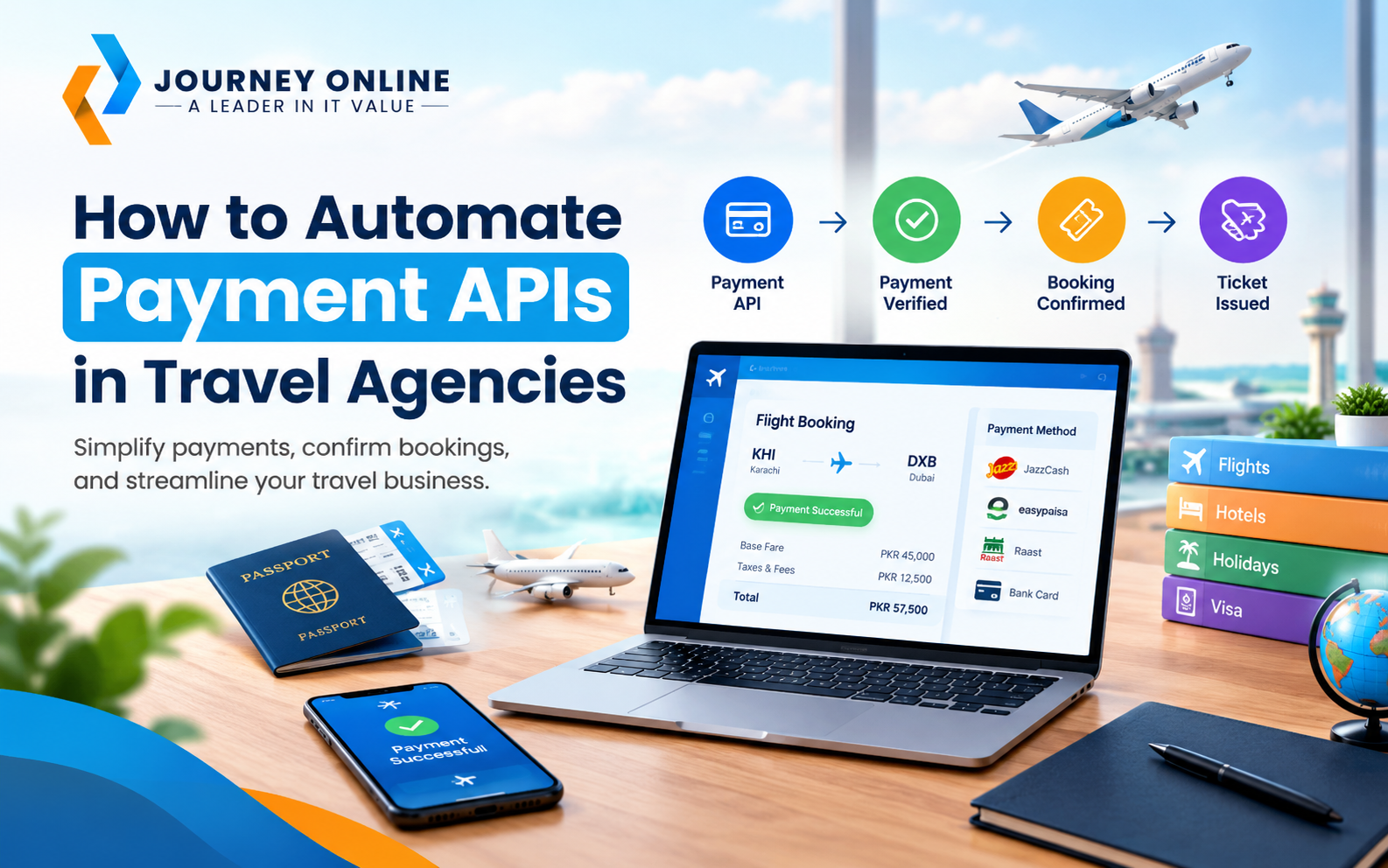
For example,when a customer books a flight through an online portal,the system can create a booking reference,initiate payment through a supported gateway,verify the result,and update the booking workflow. If the payment is successful,the system can proceed to the next permitted booking or ticketing step.
However,successful payment does not always mean a ticket has been issued. Ticket issuance may depend on seat availability,fare validity,supplier confirmation,ticketing permissions,and other operational rules.
Why Do Travel Agencies Need Payment Automation
Accurate Transactions
Travel agencies frequently manage multiple payment methods,supplier transactions,customer balances,and booking deadlines. Manual processes can make it harder to maintain accurate records as transaction volumes grow.
Payment API automation can address several common challenges.
Reduce Manual Payment Verification
Without integration,staff may need to check a bank account or payment dashboard before updating a booking. Automated status verification reduces the need for these repetitive checks.
Improve Booking Workflow Management
A booking system can use verified payment status to determine the next step,such as confirming a reservation,requesting supplier confirmation,or making a booking eligible for ticket issuance.
Keep Financial Records More Consistent
Payment references,booking IDs,transaction amounts,and customer records can be connected automatically,making it easier to reconcile receipts against bookings.
Improve Customer Communication
After a verified payment event,the system can send an appropriate confirmation by email,SMS,or WhatsApp through an authorized integration.
Improve Visibility Across Multiple Transactions
A centralized dashboard can show successful,pending,failed,refunded,and unmatched payments,helping staff identify transactions that require attention.
These benefits depend on reliable integration,correct business rules,and suitable exception handling.
How Does Payment API Automation Work
Payment Automation Workflow
A typical payment automation workflow includes the following steps.
1. Customer Selects a Travel Service
The customer selects a flight,hotel,holiday service,or another offering through the agency’s website or booking portal.
The system records the relevant details,such as the booking reference,customer information,payable amount,and applicable fare or service conditions.
2. The System Creates a Payment Request
The booking application sends a request to the backend payment service. The backend creates a transaction using the payment provider’s supported API or checkout process.
The request should include a unique transaction reference and the required amount and currency. Sensitive payment information should be handled according to the provider’s security requirements.
3. The Customer Completes Payment
The customer completes the payment using a supported payment method. Depending on the provider,this may involve a hosted checkout page,card payment,mobile wallet,or another approved payment option.
The payment provider returns a result or makes a transaction status available to the application.
4. The System Verifies the Payment
The application verifies the result using the provider’s documented process. This may include validating a signed webhook,querying the transaction status through an API,and checking that the amount,currency,merchant reference,and transaction ID match the original request.
The system should not rely only on a browser redirect or a screenshot of a successful payment.
5. The Booking Workflow Updates
Once the payment is verified,the booking system updates the transaction record and triggers the next permitted action.
Depending on the booking arrangement,this may involve confirming a booking,requesting supplier confirmation,or allowing an authorized ticketing process to continue.
If the payment remains pending or fails,the system should preserve the booking state and display the appropriate instructions.
6. The Customer Receives an Update
The system can send a payment receipt or booking-status notification after the relevant event has been verified.
Payment confirmation and ticket confirmation should be communicated separately whenever they represent different stages.
7. The Transaction Is Reconciled
Finally,the system matches the payment against the booking,customer account,and accounting records. Transactions that cannot be matched automatically should appear in an exception report for staff review.
Which Payment Methods Can Pakistani Travel Agencies Integrate
Payment Method that we use Mostly
The right payment options depend on the agency’s customers,business model,merchant eligibility,and payment provider.
Raast Payments
Raast Person-to-Merchant supports digital payment acceptance through participating institutions and service providers. Supported modes include merchant QR codes,aliases,IBANs,and Request to Pay. Availability of API-based integration depends on the bank or payment service provider and its merchant onboarding process. State Bank of Pakistan
JazzCash
JazzCash provides merchant payment integration options,including online payment solutions and APIs. Travel agencies should confirm the available payment methods,transaction-status mechanisms,fees,settlement arrangements,and eligibility directly with the provider. JazzCash Online Payment
Easypaisa
Easypaisa offers merchant services that include online payments,QR payments,and payment links. The appropriate integration depends on the merchant product and technical capabilities approved for the agency. Easypaisa Merchant Portal
Bank and Card Payment Gateways
A bank or payment service provider may offer card payments and other online checkout methods. Before choosing a gateway,agencies should confirm support for their business category,local and international cards where needed,refunds,transaction notifications,and settlement reporting.
Important: Do not assume every provider supports every payment method or offers identical API features. Verify current documentation and commercial terms before beginning development.
Essential APIs for Travel Payment Automation
Airline Distribution Systems
A reliable integration may use several API capabilities rather than a single payment endpoint.
| API or Integration | Purpose |
|---|---|
| Payment initiation | Creates a payment request for a booking |
| Payment status | Retrieves the current transaction result |
| Webhooks or callbacks | Notifies the system about supported payment events |
| Refund API | Initiates a refund when permitted by the provider |
| Booking API | Connects payment status with the reservation workflow |
| Accounting integration | Records receipts and links them to financial entries |
| Notification integration | Sends verified payment and booking updates |
The exact endpoints,authentication methods,and available events vary by provider.
For travel agencies using airline distribution systems,payment integration may also need to coordinate with the booking or ticketing platform. Payment APIs do not automatically provide access to airline inventory or ticket issuance.
How to Integrate Payment APIs With a Travel Booking System
Step by Step Payment APIs Integration
A practical implementation should begin with the business workflow rather than selecting an API solely because it is available.
Step 1: Map the Existing Payment Process
Document how customers currently pay,how staff verify payments,how bookings are confirmed,and how receipts are recorded.
Identify where delays,duplicate entries,or reconciliation problems occur.
Step 2: Select a Compatible Payment Provider
Compare providers based on:
Supported payment methods and currencies
Merchant eligibility in Pakistan
API documentation and sandbox access
Payment verification and webhook support
Refund and reversal capabilities
Settlement timelines and transaction fees
Security requirements and technical support
Step 3: Connect the Payment Gateway to the Backend
Developers should integrate the provider’s API through a secure backend service rather than exposing secret API credentials in browser-side code.
The backend should create payment requests,associate them with unique booking references,and store transaction records.
Step 4: Implement Webhook Verification
Where supported,configure authenticated webhooks to receive payment events. Verify the provider’s signature and transaction details before updating any booking or accounting record.
The integration should also handle repeated notifications safely,since payment providers may retry webhook delivery.
Step 5: Define Booking and Ticketing Rules
Specify what happens after a successful,failed,pending,or reversed payment.
For example,a successful customer payment may permit the system to continue the booking workflow,but ticket issuance should occur only when the relevant inventory,fare,supplier,and ticketing requirements have been satisfied.
Step 6: Automate Reconciliation
Match gateway transactions with booking references,customer accounts,settlement reports,and accounting entries.
Flag unmatched payments,partial payments,duplicate records,and discrepancies for manual review rather than silently marking them as reconciled.
Step 7: Test Before Going Live
Test successful and failed payments,pending transactions,repeated webhooks,timeouts,refunds,expired fares,and interrupted booking workflows.
Use the provider’s sandbox environment where available. Move to production only after the business and technical teams have verified the complete workflow.
Security Best Practices for Travel Payment APIs
Secure Payment Transactions
Travel agencies handle financial transactions and customer information,so payment automation must include appropriate security controls.
Protect API credentials. Store secrets on the server in an appropriate secret-management system. Never publish private keys or merchant credentials in frontend code.
Verify transaction results. Confirm payments through the provider’s documented server-side mechanism rather than trusting a customer’s browser redirect.
Prevent duplicate processing. Use idempotency controls or equivalent transaction safeguards so repeated requests do not accidentally create duplicate payments or bookings.
Use access controls. Restrict payment operations,refunds,and financial reports to authorized users.
Protect customer information. Collect and retain only the information needed for legitimate business purposes. Follow the gateway’s security requirements and applicable rules for payment data.
Maintain transaction logs. Record relevant event IDs,booking references,status changes,and timestamps without unnecessarily logging sensitive card or authentication data.
Prepare for failures. Define how the system responds to timeouts,delayed confirmations,unavailable gateways,and refund failures.
Where card payments are involved,confirm the applicable PCI DSS responsibilities with the payment provider and qualified security professionals.
Common Payment Automation Mistakes to Avoid
Check Everything When Transactions Proceed
Marking a Booking Paid After a Redirect
A customer may return to the website without the payment being completed or verified. Confirm the transaction through the provider’s trusted mechanism before changing the payment status.
Issuing Tickets Before Checking Booking Conditions
A payment can succeed while the fare changes,inventory becomes unavailable,or a supplier rejects the booking. Use explicit booking-state rules and handle failures safely.
Ignoring Pending Payments
Pending transactions should remain identifiable and be checked according to the provider’s documented status process. Do not automatically treat them as successful or failed without evidence.
Failing to Handle Duplicate Notifications
Payment events may be delivered more than once. Processing must be safe to repeat without creating duplicate receipts,bookings,or accounting entries.
Reconciling Only the Total Amount
A daily settlement total may not reveal which bookings remain unpaid or which transactions have been refunded. Match individual transaction references and investigate discrepancies.
Forgetting Refund Workflows
Refunds should be connected to the original transaction,recorded accurately,and communicated to the customer once their status is confirmed. A requested refund is not necessarily a completed refund.
Payment Automation and Accounting for Travel Agencies
Well Intergrated Payment APIs
Payment processing and accounting are related,but they are not the same task.
The payment gateway reports transaction activity. The booking system manages reservations and ticketing workflows. The accounting system records financial effects and supports reconciliation.
A well-integrated setup connects these systems while preserving their separate responsibilities.
For example,when a customer pays for a booking,the system can associate the payment with the correct customer and booking reference. Accounting entries should then follow the agency’s approved accounting rules,including the appropriate treatment of supplier liabilities,service fees,commissions,refunds,and taxes where applicable.
For IATA-accredited travel agents,airline settlement is another distinct process. IATA’s Billing and Settlement Plan provides a framework for sales reporting and settlement between participating agents and airlines. A customer payment gateway does not replace BSP reporting or settlement obligations. IATA Billing and Settlement Plan
The goal is to reduce duplicate data entry while keeping booking records,payment transactions,and financial reports consistent.
How Journey Online Can Help Travel Agencies
We Offers Payment APIs Integration
Travel agencies looking to digitize their operations can evaluate how a travel technology solution fits their booking workflows,payment requirements,and accounting processes.
Journey Online provides travel technology solutions for agencies that want to manage and improve their digital operations. Before implementing payment automation,an agency should identify the required payment providers,booking platform,supplier integrations,accounting workflow,and customer communication channels.
A requirements discussion can help establish which processes are suitable for automation,which integrations are technically available,and where manual approval should remain necessary.
Frequently Asked Questions
Payment APIs Automation FAQs
What is a payment API in a travel agency?
A payment API enables a travel booking system to communicate with a payment provider to initiate payments,retrieve transaction status,and use other supported payment functions.
Can Pakistani travel agencies automate payments through JazzCash or Easypaisa?
Potentially,yes. Both providers offer merchant payment services,but the exact API features,payment methods,eligibility,and integration process must be confirmed with the provider.
Can payment automation issue airline tickets automatically?
It can support an automated ticketing workflow when the relevant booking and ticketing integrations permit it. Payment confirmation alone does not guarantee ticket issuance; availability,fare validity,supplier rules,and ticketing permissions must also be checked.
How do payment APIs help with accounting?
They can provide transaction references and payment status that can be matched with booking and accounting records. Automated reconciliation still requires correct mapping,reliable settlement data,and exception handling.
What happens when a payment succeeds but the booking fails?
The system should identify the mismatch,prevent an incorrect booking confirmation,and follow the agency’s defined recovery or refund process. The customer should receive an accurate status update.
How long does payment API integration take?
The timeline depends on the payment provider,quality of documentation,merchant approval,existing booking software,security requirements,and testing scope. A simple checkout integration generally involves less work than a complete booking,ticketing,refund,and accounting automation workflow.
Conclusion
Ready to Automate Your Travel Agency's Digital Operations?
Looking to streamline your travel agency's booking and payment workflows? Contact Journey Online to discuss your business requirements and explore suitable travel technology solutions.
Phone
+92 310 0007901
+92 333 7323379
Website: https://journeyonline.pk/
Journey Online — Travel Technology Simplified.